

From grape residues to high-performance materials, Vegea’s GrapeSkin challenges the foundations of luxury, proving that scalability, consistency, and environmental accountability can coexist under real industrial conditions.
By Ehab Soltan
HoyLunes – In the global materials industry, a structural shift is unfolding—quietly, but with far-reaching implications. For decades, luxury was defined by extraction: rare resources, animal-derived materials, and processes built on scarcity. Today, that logic is being challenged not from within the system, but from its margins—through the industrialization of agricultural by-products.
Italian innovator Vegea S.R.L., founded in 2016, is not simply participating in this shift; they are accelerating a structural break. Their signature material, GrapeSkin, is forged from the remnants of grape processing, deeply rooted in the Italian winemaking identity. It emerges not just as a bio-based alternative for fashion, interiors, and automotive.
Now, marking its 10th anniversary, Vegea has announced a strategic expansion of its GrapeSkin production capacity. While initially an industrial milestone, it signals something far greater: a structural validation. This is no longer about potential; it’s about proof of performance and scalability, raising a compelling question for the entire industry: What if true luxury is no longer about the material itself, but about the nature of its impact?

From Laboratory Innovation to Industrial Repeatability: The Engineering Challenge
The journey from a laboratory concept to robust industrial production is not a mere scale-up; it’s a rigorous test of coherence and engineering precision. Many promising sustainable materials stumble at this very juncture. They demonstrate undeniable potential in prototypes, yet struggle to maintain consistency in texture, resistance, and performance when produced at scale – the replicability that global brands demand.
Vegea’s strategic expansion, incorporating enhanced production lines and new dedicated units, directly confronts this challenge. However, the critical narrative isn’t about volume; it’s about unwavering quality and predictable performance. To understand how Vegea successfully navigated this complex transition, we spoke with Marco Valtolina, Head of R&D at Vegea S.R.L.
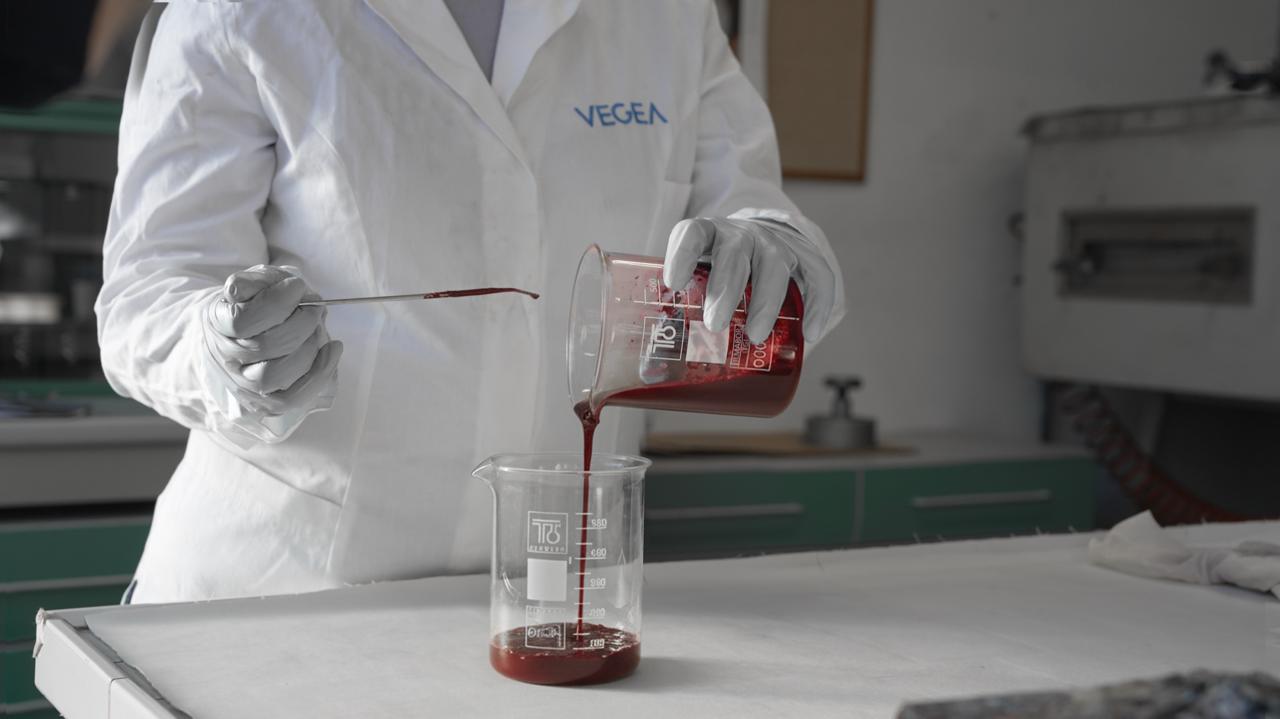
“Scaling GrapeSkin from a laboratory concept to a reliable industrial material required an extensive effort in process engineering, digitalization, and supply-chain stabilization,” explains Marco Valtolina. The main challenges were primarily technical: defining the optimal synthesis parameters, controlling the variability of biobased inputs, and ensuring that each production step (polymerization, coating, and finishing) could be replicated at industrial scale with the same precision achieved in the lab.
Marco Valtolina continues, “The transition demanded deep optimization of process conditions such as temperature profiles, residence times, and formulation ratios. These parameters, which in the laboratory can be fine‑tuned manually, need to be translated into industrial protocols capable of guaranteeing repeatability day after day. To achieve this, Vegea invested in advanced digital control systems, incorporating real‑time monitoring, automated regulation loops, and AI‑supported assistance systems that help operators maintain ideal process windows”. This robust infrastructure allows Vegea to track and adjust every critical variable, ensuring that GrapeSkin maintains its signature high performance: mechanical strength, resistance to hydrolysis and chemicals, and durability under sunlight and extreme temperatures.
Another decisive factor, according to Marco Valtolina, was the stability of raw materials. “Although GrapeSkin is 92-96% biobased, we avoided the typical variability issues of bio‑materials by establishing long‑term agreements with trustworthy suppliers who guarantee consistent biomass quality. Combined with the decade‑long experience of Vegea’s technical team, this approach allowed us to scale up without compromising on the identity or performance of the material”.
What further reinforces this stability is a structural advantage often overlooked in bio-based materials: Vegea currently uses less than 1% of the grape by-products generated in Northern Italy. This means that even significant fluctuations in agricultural output have a negligible impact on supply consistency. In strategic terms, GrapeSkin is not exposed to the volatility typically associated with biological feedstocks—an uncommon position that strengthens both scalability and industrial reliability.
Defining and Measuring Performance Across the Lifecycle: Beyond Narratives to Data
The industry-wide conversation around “responsible luxury” is intensifying, yet it is rarely subjected to rigorous, quantifiable scrutiny. GrapeSkin introduces a concrete, verifiable proposition: vegetal content, animal-free composition, and seamless integration within a circular economy model that encompasses sourcing, production, and end-of-life considerations. The true disruption, however, will not be driven by compelling narratives, but by measurable outcomes.
We asked Marco Valtolina how Vegea defines and validates the environmental performance of GrapeSkin. “The environmental performance of GrapeSkin is rooted in both its material composition and its production model, which aligns with circular economy principles from raw material sourcing to end‑of‑life”, Marco Valtolina states. “First, GrapeSkin is more than 92% biobased, a percentage significantly higher than many other materials on the market that label themselves as ‘bio‑based’ despite containing only minimal renewable content. The bulk of the formulation consists of grape processing residues, vegetable oils, natural fibers, and recycled inputs. This reduces dependence on fossil resources while valorizing agricultural byproducts that would otherwise be discarded”.
Marco Valtolina details their low-impact process, which is designed to minimize environmental load: it uses vegetable, renewable, and recycled raw materials, avoids toxic solvents, heavy metals, and hazardous chemicals, and consumes minimal energy across extraction, polymerization, and coating steps. Vegea is moving beyond internal assessments, using Life Cycle Assessment (LCA) methodologies developed in collaboration with research institutions to examine carbon footprint, resource use, and overall environmental impact compared to traditional leather and synthetic alternatives.
The company also undergoes audits for crucial certifications like the Global Recycled Standard (GRS), verifying traceability, chemical compliance, social impact, and environmental responsibility throughout their production chain.
Finally, durability plays a fundamental role: “a GrapeSkin product lasts for many years without degradation of mechanical or aesthetic properties”, explains Marco Valtolina. “This longevity significantly reduces the replacement rate of finished goods, translating into lower resource consumption and a reduced environmental footprint over the full product lifecycle”.
This shift—from narrative-driven sustainability to data-verified performance—is where materials like GrapeSkin begin to differentiate not only ethically, but competitively.

Looking Ahead: Premium Excellence and The Democratization of Quality
Vegea’s case is not isolated—it reflects a broader redefinition of value, unfolding story: the redefinition of value itself. For nearly a century, luxury was measured by what we extracted from nature. Today, it is increasingly being measured by how we integrate with it, respect it, and innovate within its systems. Vegea does not represent a final solution; it represents a direction – and in an industry heavily weighted by inertia, changing direction is, in itself, a strategically disruptive shift.
When we look at the future of GrapeSkin, whether it will remain a niche, premium material or evolve into a globally scalable alternative depends on key conditions: targeted investment that preserves its fully Made-in-Italy identity and uncompromising quality, a rising market momentum for sustainable, high-performance materials – particularly in fields like automotive and lifestyle where demand is strong and evolving quickly – and maintaining the same precision, care, and attention that defines it today. These are the foundations of enduring, strategic disruption.
The strategic question is no longer whether materials like GrapeSkin can perform. That question has already been answered. The real question is which companies are prepared to integrate these materials into their value chains without compromising identity, margins, or consistency—and which will remain observers of a transition already underway.
The conversation that matters isn’t what these companies are saying; it’s what they are doing and the tangible impact they are achieving, proving that true strategy is designed with rigor and executed with profound responsibility. This is the new standard of excellence in the materials and technology sectors, an open invitation for purposeful collaboration and the shared design of a truly sustainable future.
For companies willing to engage, the window to shape that future is still open—but narrowing.
Sources and Key Frameworks:
European Environment Agency – Circular economy frameworks
Ellen MacArthur Foundation – Materials and circular systems
McKinsey & Company – The State of Fashion & Sustainability and HealthTech analysis
#CircularEconomy #MaterialsInnovation #SustainableMaterials #ResponsibleLuxury #BioBasedMaterials #IndustrialInnovation #Vegea #HoyLunes #EhabSoltan #GrapeSkin #MarcoValtolina